Signed in as:
filler@godaddy.com

Governor DeWine wants to rebid the state’s contracts with Managed Care Organizations (MCOs) that manage billions of dollars of Medicaid benefits for the first time since 2011. 1 in 4 Ohioans are covered by Medicaid, which has a $28.2 billion budget for fiscal year 2019. A mixture of state and federal dollars fund low-income insurance program, the majority of which is managed by private health insurance companies contracted by the state. The Ohio Department of Medicaid just finished its public comment period through an RFI (request for information) from stakeholders, marking the beginning of the process for the department to select new managed care partners. According to the Department of Medicaid, over 300 organizations sent in comments to weigh in on the process. Questions focused on a variety of areas including communication, access to care, payment innovation, and social determinants of health in managed care. There are no details yet on what could changes could be coming, but rebidding the contract lets state officials look for cost savings and explore ways to improve health care by tying payments to quality outcomes. We see this as an opportunity for the Department to focus on adjustments and improvements that could be made to better serve Ohio’s children and families, specifically in social determinants of health and equity and creating a comprehensive, continuum of care for vulnerable populations. New contracts tentatively will take effect in January 2021.

Governor DeWine, on his first day of office, convened the Governor’s Advisory Committee on Home Visitation. This committee was tasked with submitting recommendations to help expand evidence-based home visiting to three times as many families. The committee’s report was submitted in March 2019, with members coming from 20 individuals with diverse backgrounds in professions including pediatrics, mental health, developmental disabilities, home visiting.
We know that the first 1,000 days of a child’s life – conception to age 2 – lays the foundation for the rest of a child’s life. In a child’s first few years, more than 1 million new neural connections are formed every second. It is important, then, that a child is set up for success in life through healthy brain development. This includes proper nutrition, if a child is exposed to toxins and infections or not, and the child’s experiences with people and the world. This is where home visting comes in: by providing resources for at-risk families and to allow those children to grow exponentially through tools and services that might not otherwise be available to them or be known to their family.
Currently, Ohio has three evidence-based home visiting models, administered through “Help Me Grow” to serve at-risk children and their families. These include the Nurse-Family Partnership, which is for first-time, low-income pregnant women. 715 families were served through NFP in 2018. The second program is Healthy Families America which is designed for single parents, those in poverty, and various adverse childhood experiences. 7,500 families were served with HFA in 2018. The last model is the Parents as Teachers program, which strives to increase parent knowledge of early childhood development and parenting practices, provide early detection of developmental delays and health issues, prevent child abuse and neglect, and increase children’s school readiness. In 2018, 700 families received services through PAT.
Early Intervention is also an aspect of “Help Me Grow,” and provides services for children with developmental delays or disabilities. These services are available in all 88 counties, and wait listing is prohibited by federal law. 22,000 children were served by Early Intervention services in 2018and is below the average of children served in comparable states. Country boards of developmental disabilities can provide around 95% of EI services, and of children served for at least 6 months, up to 68% of children were functioning at age expectation as they exited the program.
By focusing on a two-generational approach for home visiting, the Governor is looking not only to address the needs of children and their early development, but also keeping families strong. Investments in high quality early education also produce a $5.70 return for every dollar through reduced social costs and higher academic performance, making this a smart investment for the state’s future workforce. Currently, however, only 6% of eligible families are being served with home visiting services. The Committee on Home Visitation released 20 recommendations to help in the Governor’s goal. These include, but are not limited to:
Through the cultivating of Ohio’s home visiting, evidence-based programs, we can grow strong children and strong families. This investment in a child’s first 1000 days will not just benefit the child throughout their life, but also benefit Ohio’s economy and workforce in years to come.

In the wake of the tragedy in Dayton, Governor DeWine has announced that, along with the Ohio Children’s Hospital Association they will be hosting a childhood mental health summit called “Building Resiliency." The Governor said that this summit will be a call to action, “What we’re doing today is one more step,” DeWine said. “We want everyone to know what trauma looks like.” The Governor emphasized that children cannot be forgotten in the wake of today’s tragedies. This summit, open not only to health care professionals, and teachers, but also to parents, will help teach how to identify signs of trauma and ways to help address it.
Deborah Feldman, president and CEO of Dayton Children's Hospital and chair of the OCHA's board, said the summit should have a lasting positive impact by "bringing together the best minds in pediatric mental health and the critical partners who work on the front lines with children across the state is an important first step in creating real solutions that will not only build resiliency in children today but also give them the tools and resources they need well into the future," she said.
The summit, taking place in Dayton on September 26, marks an important step in addressing trauma in Ohio’s children and learning how to recognize mental health issues in children. A companion guide, Growing Resilience, is available now to help parents understand the impact of trauma and how to help them heal. Registration information for the summit is available now. Register today!
According to the Health Policy Institute, Ohio ranks 35th in child poverty, 38th in adverse childhood experience, and 28th in preschool enrollment. The state has recognized that Ohio has room to grow when it comes to giving children the brightest future possible.
The most obvious investment was $675 million in Student Wellness and Success, intended to provide wraparound services in K-12 schools. These programs help address a child’s overall well-being for desperately needed services, such as mental health, health case, mentoring, family engagement and support, and homelessness resources.
The most recent data from CWLA in 2016 shows us that the percentage of children in poverty under the age of 18 was 21%. For every 100 poor families with children, only 22 received TANF cash assistance. In this budget the Ohio Association of Foodbanks received funding for expanding summer meal program options.
In 2016, Headstart served 36,145 children in Ohio, a 2.7% increase. In HB 166, $100 million is being invested in Quality Infrastructure grants to increase efforts to meet Step Up to Quality mandates. An additional $2 million was included for the Early Learning Pilot Program to increase quality child care in rural communities. The Governor’s Imagination Library was created and funded with $5 million in the first year of the biennium as an effort to improve early literacy in the state.
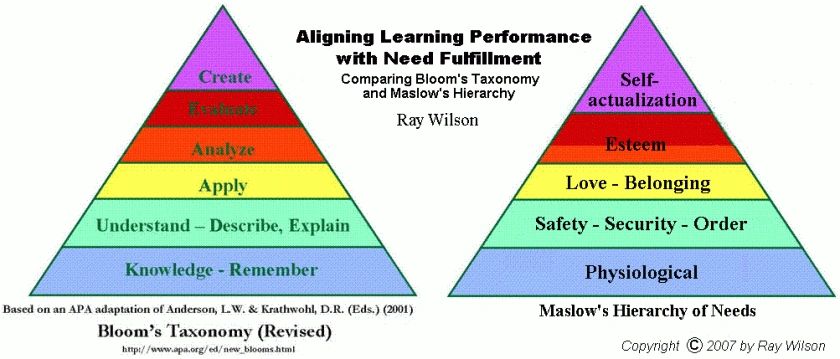
You may have seen this graphic or the phrase “You have to Maslow before You Can Bloom." recently on social media. This concept which has recently gone viral is in reference to Maslow's Hierarchy of Needs and Benjamin Bloom's Taxonomy of learning complexity. This graphic reminds us that our policy-making needs to begin with non-academic factors if we want to see academic successes. When students are hungry, when they do not feel safe, when they are traumatized, how can they be expected to focus on their lessons? We need to understand that what we input into our children’s environment directly affects long-term outputs. The more students’ needs are met, the more they can learn and grow.
What if We Expanded Early Childhood?. Groundwork Ohio recently published this factsheet exploring how expanding early childhood will have positive impact on Ohio’s families and children.
The Pay Gap in Early Childhood Education. One in a series of “policy notes” published by the Crane Center for Early Childhood Research and Policy on various issues pertaining to children’s well-being and recommendations to meet those challenges. They are designed for policymakers and others who are interested in formulating best practices as they relate to children’s learning and development at home, in school and in the community.
Child Care Access in 2020: How will pending state mandates affect availability in Franklin County, Ohio? By July 2020, all providers that receive publicly funded child care (PFCC) must be in the state’s star rating system, Step Up to Quality. This is true for centers as well as home providers. Providers that fail to apply for and/or gain entry (one star) will no longer receive public funds. This white paper examines what the impact of this requirement might be on the publicly funded child care landscape in Franklin County, Ohio.
Ohio Children’s Budget Coalition. On August 5, 2019, the Coalition published its policy scorecard reporting how children fared in the state budget. Check out the scorecard to learn more about progress made and where additional work is needed.
KIDS COUNT State and County Profiles. On August 1, 2019, Children’s Defense Fund-Ohio published its annual state and county profiles on child well-being. Check out the statewide profile or dig into any one of the 88 counties included in the publication.
Maximize Federal Support to Feed Ohio. On August 19, 2019, Policy Matters Ohio published this analysis of the proposed federal action to limit the SNAP program and what Ohio can do to make sure no Ohioan goes hungry.
The 2019 PCSAO County Factbook. Published on March 29, 2019, this Factbook by Public Children’s Services Association of Ohio (PCSAO) is designed as a resource for policymakers and the media; for federal, state, and local partners; and for those interested in the safety and stability of Ohio’s children and families. This edition includes children services-specific program and fiscal information for each of Ohio’s 88 counties.
Next Children’s Caucus Meeting: Tuesday, September 17, from 8:00 am to 9:00 am. at the Riffe Center (Rm. 1960). The theme will be the first 1,000 days and focus on early childhood. Breakfast will be served and we ask that you RSVP to Sen. Lehner's Office at (614) 466-4538.
Governor DeWine's Child Mental Health Summit. Building Resiliency: A Pediatric Mental Health Summit. Thursday, September 26th. Register today!
Children’s Scorecard Subcommittee: October 3rd at 10AM Riffe Center ( Room 1924 ). Please contact Senator Lehner's Office at (614) 466-4538 if you would like to participate.
Early Childhood Education Meeting: Friday, October 11th 31st floor of the Riffe Center, North Room
